

I have always been fascinated by Horst’s 1939 photograph Bacchanale, showing costume designs by Salvador Dali for Russian choreographer Léonide Massine’s Ballet Bacchanale. Itwas a one-act ballet, set to music by Richard Wagner. Ballet criticJack Anderson described prudish audiences blushing over the “male ensemble with large red lobsters on their thighs”, and the dancer portraying Venus creating a sensation by appearing totally nude. In actuality she was wearing “flesh-coloured tights from her neck to her toes”. Other costumes included a rose-coloured fish head, a hoop skirt covered in teeth, and an enormous perambulating umbrella.
Bacchanale was the first of 10 ballets designed by Dali to be produced in New York from 1939 to 1949, and the first for Les Ballets Russes de Monte-Carlo, the company that preserved the legacy of Serge Diaghilev’s Les Ballets Russes, whichfolded after the legendary impresario’s death in 1929.
Massine was the new company’s main choreographer. He first met Dali when he was staying with Coco Chanel at her house in Roquebrune, shortly before the company left for a tour of the US. Dali would have been intrigued as Les Ballets Russes had a history of working with leading artists, including Juan Gris and Pablo Picasso, continued by its successor.
Bacchanale had its world premiere as the second of a triple bill at the Metropolitan Opera House It was preceded by Rouge et Noir, with designs by Henri Matisse and followed by La Boutique Fantasque, designed by André Derain. For his ballet, Dali chose the Venusberg music from Wagner’s opera Tannhäuser as the summit, because it was as he expressed it, of “Wagner’s theatrical ascension.”
Horst, whose work had been influenced by surrealism, was the perfect photographer to capture the lead dancers in their costumes. The resulting image is a masterpiece, where Horst showed his skill with chiaroscuro effects, achieving high drama in probably the most enigmatic photograph he ever created.
For years, I looked for a vintage print of Bacchanale but I don’t recall ever having seen one, never mind one that was for sale.
Yes, there were printed later versions available, produced in the 1980s, but my collecting is focused on vintage prints, so I gave them a miss.
Late one evening in June 2022, I was scrolling through eBay, writing in various search words, and “Horst” gave some interesting results, namely copper photogravure plates. They were split between two dealers, none of whom were specialised in photography or the arts, each offering a range of wares, coffee makers, gloves, lamps, etc. It turned out that the plates had been bought as one lot at an estate sale and then split.
These were the copper plates used to print the photographer’s first book, Horst: Photographs of a Decade, published by J. J. Augustin in 1944. And amongst them was the copper plate for Bacchanale. All the plates on offer were attached to wooden bases and wrapped in brown paper, with printed papers of the contents attached to it. On the back of the wooden bases were proof prints, soiled with ink, darkened with age.
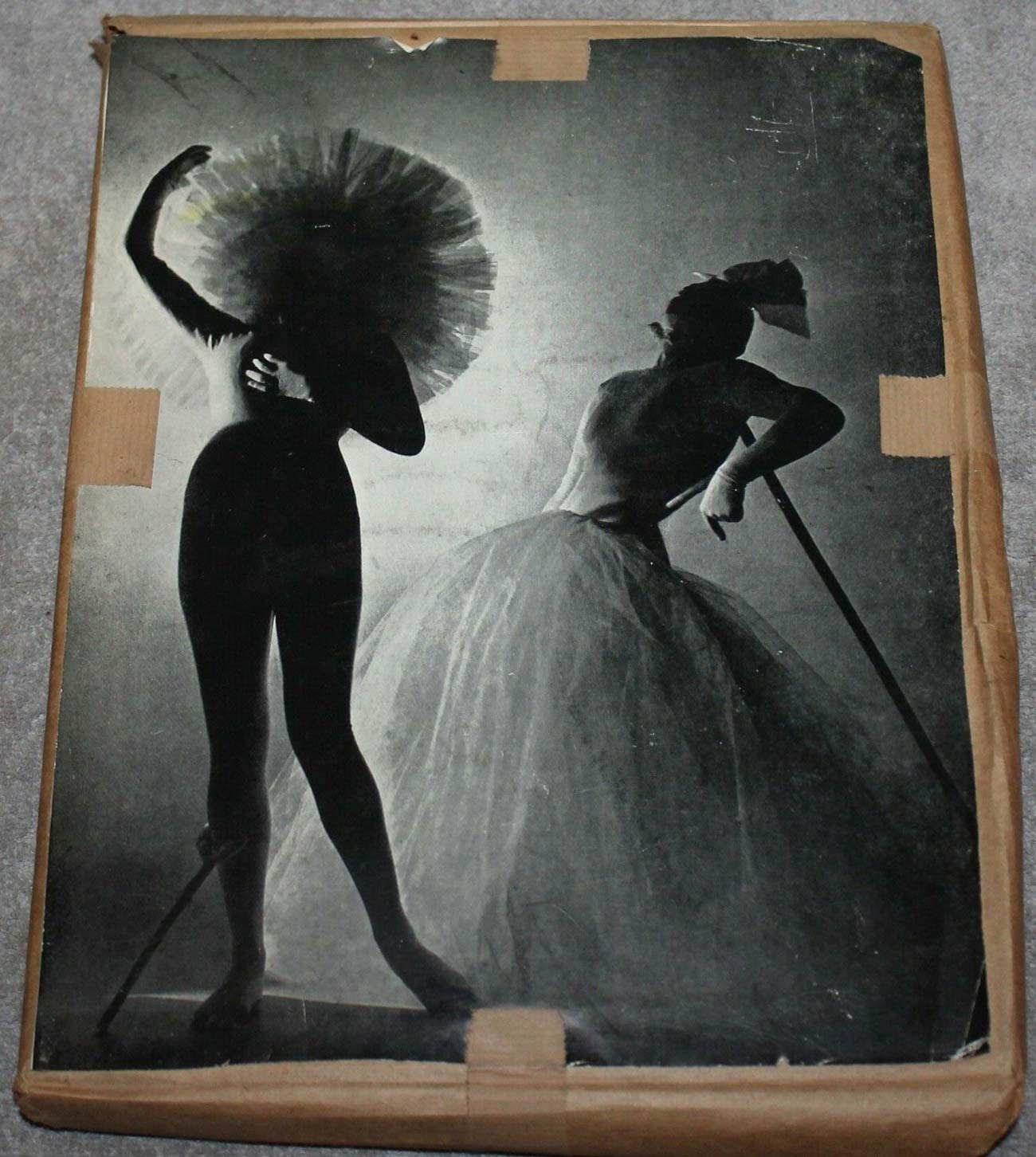
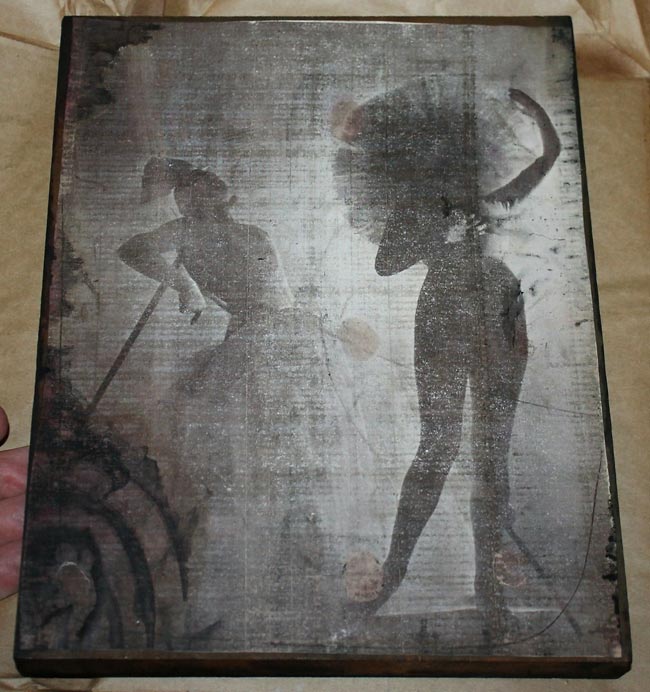
The plates had not been cleaned, just unwrapped for eBay, and it was impossible to tell from the snapshots if they were scratched or damaged in some other way. The surfaces were almost completely black, from ink and grime, with just a hint of what might be beneath.
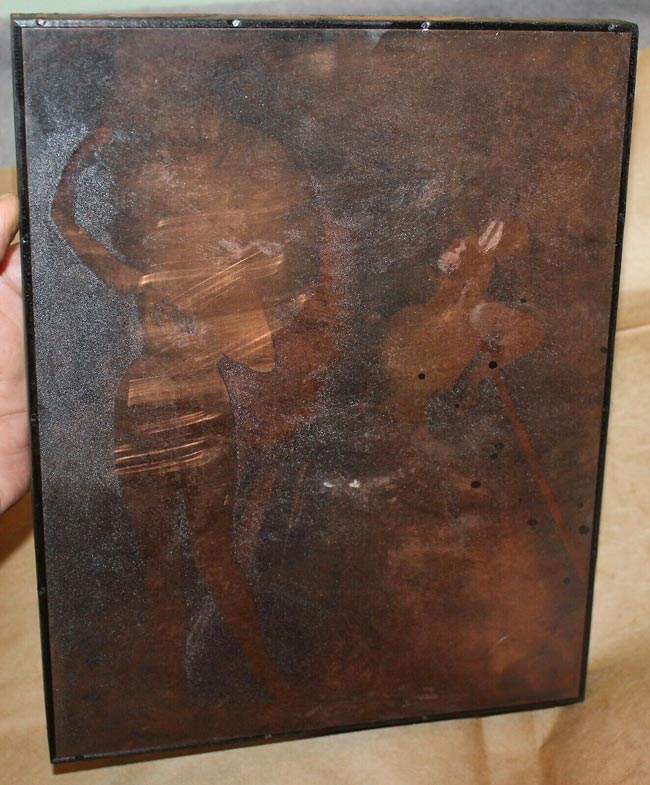
Anyway, I decided to take the plunge and I bought the plate for $1385 including shipping. I received the plate a week later. Some off-the-shelf metal polish removed the ink and the grime and there it was, Bacchanale.
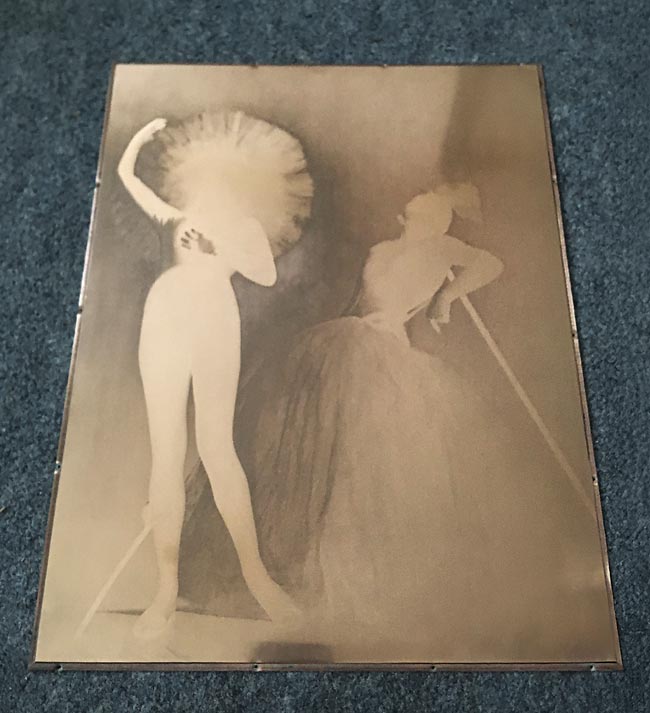
I found this way more intriguing than a print, the reflection in the copper giving the image another mysterious dimension.
Horst: Photographs of a Decade also included Mainbocher Corset, another incredible image. Neither dealer had it, nor did they know, or wanted to divulge, where it had ended up.
J.J. Augustin published a second book of photographs by Horst, Patterns from Nature, in 1946,as well as four titles by Horst’s partner George Hoyningen-Huene.