

Miriam and Eunice Teller, born in 1770, were of age to vote for George Washington in 1792, but they lived in New York where women were not allowed to vote. At that time, only one state allowed women to vote, New Jersey, as voting was then decided on a state-by-state basis. By 1860, when Abraham Lincoln was elected, suffrage for women had become a major topic of discussion, but women such as the Teller sisters, then 90 years old, were still barred from voting for a candidate. In 1920, when the 19th Amendment to the Constitution passed, women were finally allowed full voting rights.
What separates the Teller Twins from the thousands of people who may have lived long enough to vote for both Washington and Lincoln, if voting had been universal? The twins had a face-to-face encounter with George Washington when they were six or seven. Amazingly, that meeting was documented in Benson Lossing’s book, The Hudson, from the wilderness to the sea, published in 1866.
Miriam and Eunice Teller grew up with six brothers and sisters in Croton-on-Hudson in Westchester County, a prosperous farming area that during the Revolutionary war became a kind of no-man’s land for roving bands of opportunists known as Cowboys and Skinners.
The Teller family can be traced back to the 17th century when as explained on the Stoutenburgh-Teller website, “Cornelius van Bursum was the first to purchase Croton Point from the Indians in 1682. A few years later, William and Sara Teller were given permission to live on the point and operate an Indian trading post. In the 18th century the area came to be known as ‘Teller’s Point’.”
The website continues, “William Teller Jr. the man with the trading post, was an elder in the Sleepy Hollow Church. He acquired large tracts of land in Westchester County-there is still a Teller Avenue there-one tract now the town of Ossining, a portion projecting into the Hudson River was known as Teller’s Point, separating Tappan and Havershaw bays-two miles in length, and was purchased by him of the Indians (who called it Se-was-gua) for two barrels of rum and twelve blankets.” His old stone house was standing in 1866 according to Lossing’s 1866 book on the Hudson River.
Pierre Teller, the grandson of William Teller Jr., and father of the twins and six other children, fought with Colonel Drake’s Company in the 3rd regiment of the Westchester County Militia. He was wounded in a skirmish in 1783 and died in a British prison the same year. Teller’s death left the twins and their six siblings to their mother’s care.
The twins, then 90 years of age when they met Lossing, still lived in or near Croton-on-Hudson when someone brought the writer to meet Miriam in 1860.Miriam’s recollection of her experience, which had occurred 80 years or more prior to her meeting with the author, was precise and crystal clear as he explained in his book.
They had both lived in that vicinity (Croton-on-Hudson) since their birth, having married and settled there in early life. Mrs. Williams (Miriam) had a perfect recollection of Washington, when he was quartered with the army near Verlanck’s Point. On one occasion, she said, he dismounted in front of her father’s house and asked for some food. As he entered, the twins were standing near the door. Placing his hands upon their heads, he said, “You are as alike as two eggs. May you have long life.”
He entered with her father, and the children peeped curiously in at the door. A morsel of food and a cup of cold water was placed upon the table, when Washington stepped forward, laid his hand upon the board, closed his eyes, and reverently asked a blessing, their father having, meanwhile, raised his hat from his head. “And here”, said Mrs. Williams, pointing to a small oval table near her, “is the very table at which that good man asked a blessing”.
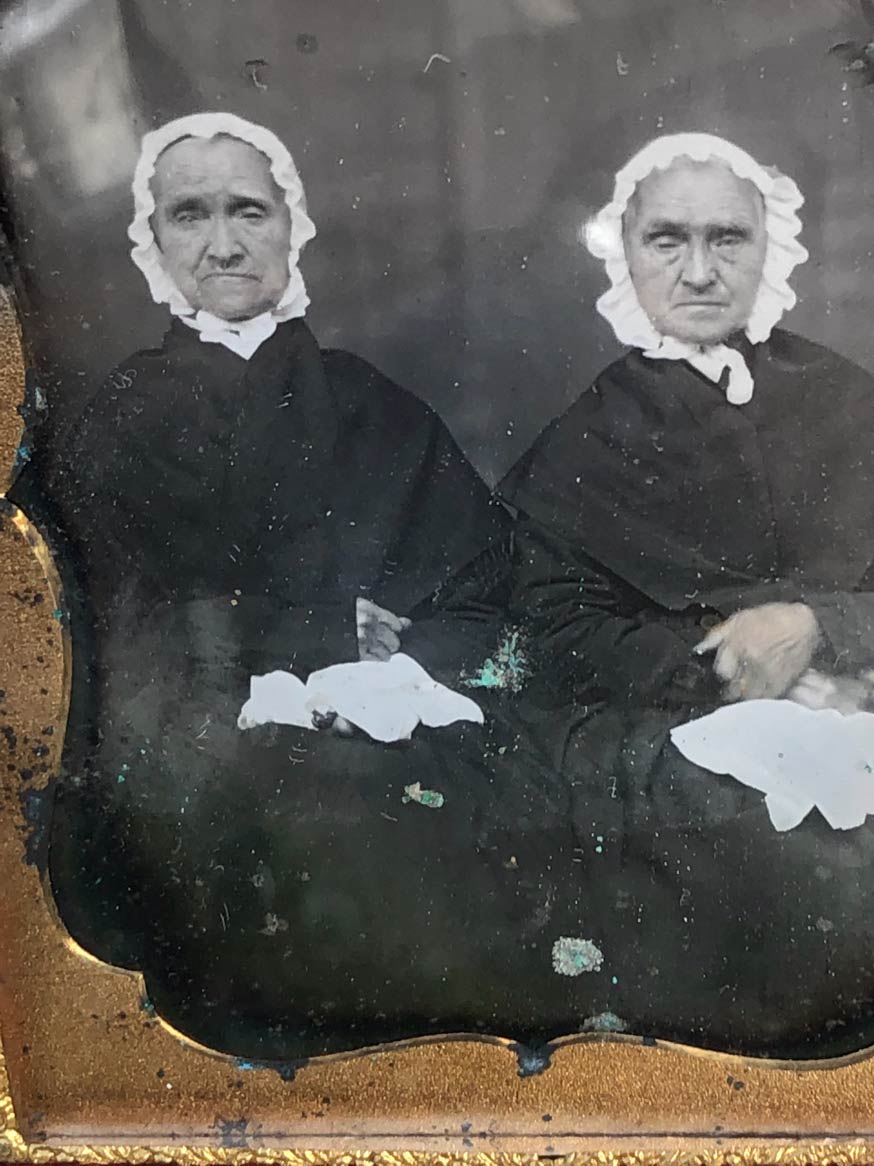
The daguerreotype of Miriam and Eunice, along with their documented story, offers a tale that Ken Burns might have included in his Revolutionary War series if he had known the details. During that war, two young girls met the Father of our Country, two decades before they were unable to vote for him as President, and 150 years before they, as women, would have been able to vote at all.